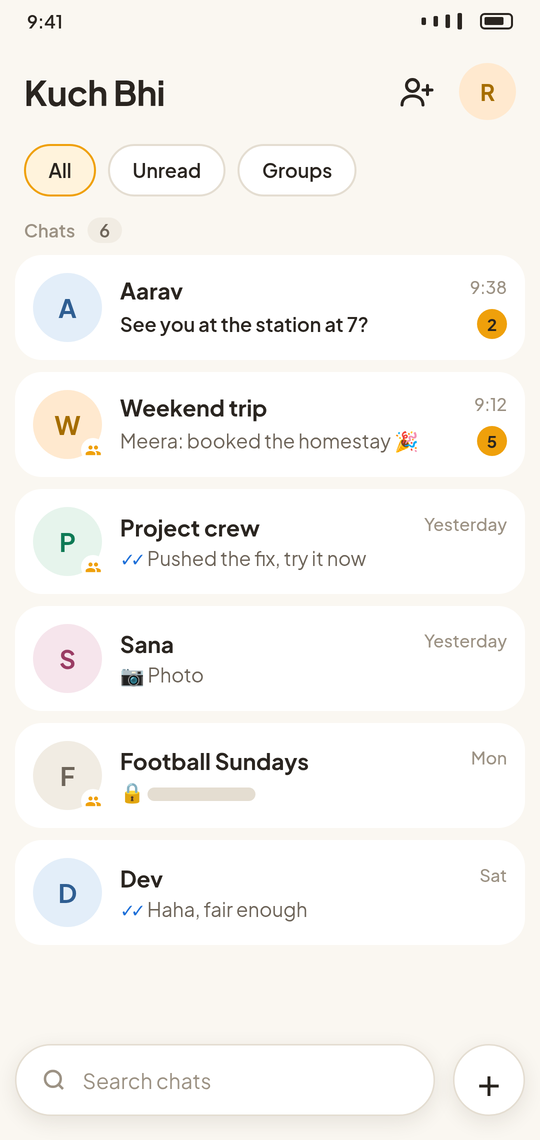
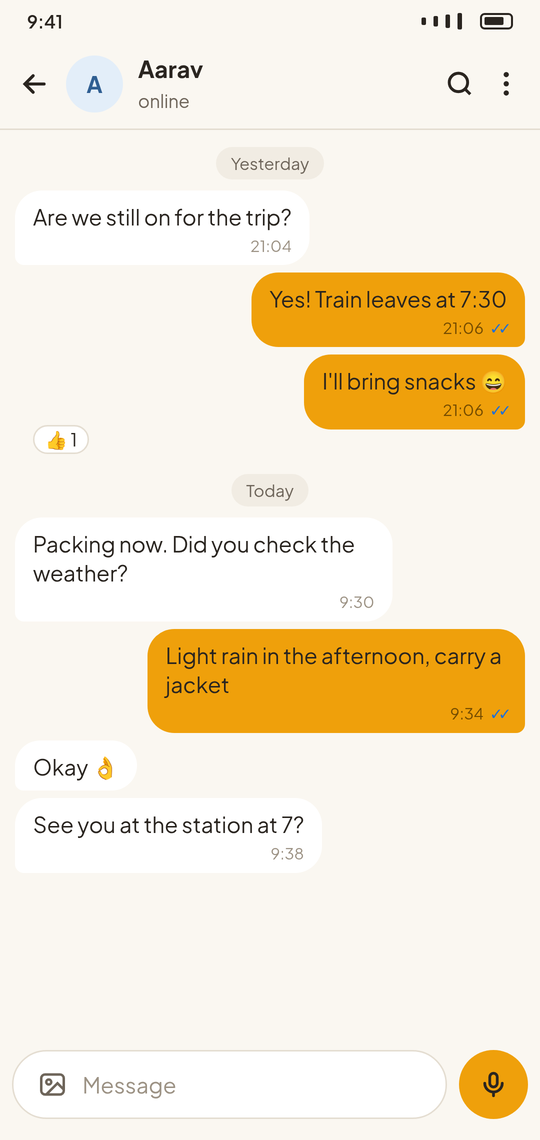
Mockups with demo names and messages, drawn from the app’s real design.
The problem
I wanted a chat app for friends where the server can’t read the messages, that works offline, and that I host myself. Doing that properly means handling the hard parts: key exchange, group keys that change when people join or leave, and a backend whose rules stop one user reading another’s data.
Design
Flutter app (Android)                         Oracle Cloud Always Free (Ubuntu, Ampere)
 ├─ UI ─ Riverpod ─ repositories               ├─ PocketBase (auth, realtime, API rules)
 ├─ Drift / SQLite (offline-first store)  ◄──► ├─ JS hooks (membership, deletion, media expiry)
 └─ crypto in a background isolate             └─ Python FCM notifier (systemd service)
    X25519 key exchange + AES-256-GCM            Firebase Cloud Messaging · Google sign-in
- Offline-first: messages load from the local database at once and sync in the background.
- Crypto off the main thread so the UI never stutters.
- Delivery and read receipts as a state machine (sent → delivered → read).
- Media sharing with server-side expiry.
What is secured, and how
- End-to-end encryption. X25519 key agreement and AES-256-GCM; the server only stores ciphertext.
- Group key rotation. New key versions go only to current members, so removed members can’t read future messages; old versions are kept so current members can still read history after a cold start.
- Server-side authorisation. PocketBase API rules and hooks enforce chat membership, “delete for everyone” and former-member access on the server, not just in the app. Each rule change has a dry-run and a live check script (
docs/server/tests/). - Two security audits of my own code (30 Oct and 16 Nov 2026), covering client crypto, local data, network and auth, server rules, Android and secrets. Confirmed findings were fixed and re-tested on a device. One example: a QR-code path could pass unvalidated text into a server query filter; it is now validated at the repository boundary.
- Hardened VM. SSH with keys only; a host firewall; administrative access only from my own devices over a Tailscale private network; Oracle Cloud ingress rules tightened to match.
- Secrets kept out of the repo. Server credentials live in a
chmod 600environment file loaded by systemd, never in the repository.