RogueAP Shield runs as a Windows service, checks every Wi-Fi network you join against seven independent signals, and reacts when one looks like a rogue access point: it warns you, brings up your VPN, or blocks traffic until the VPN is up.
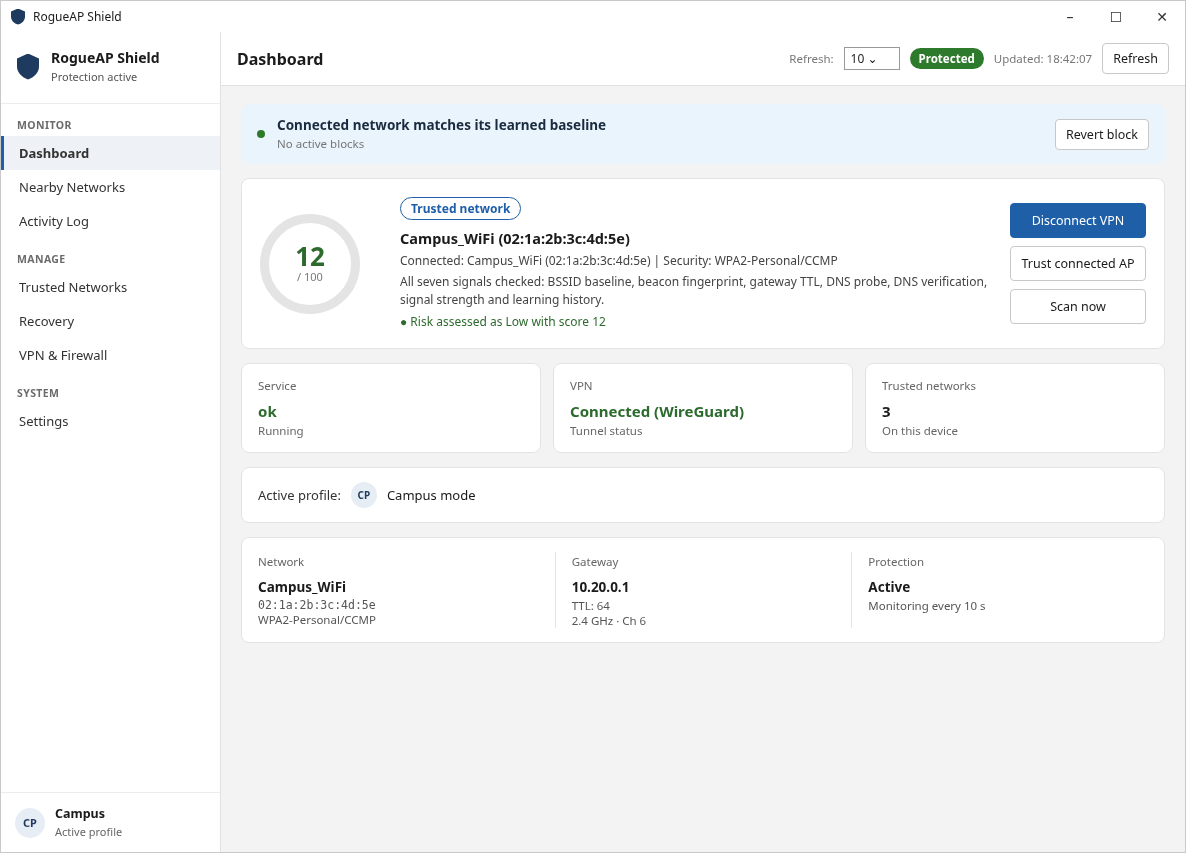
Mockup of the real dashboard with a demo network.
The problem
An attacker with a phone hotspot can copy a café’s or campus’s network name (SSID) and even its MAC address. Laptops join it automatically, and from then on the attacker sits in the middle of the traffic. Checking the name or a single MAC isn’t enough; the fake has to be caught by several things that are hard to fake at once.
Design
Windows Native Wi-Fi scan ─► 7 detection signals ─► weighted risk score ─► policy ─► action
                                                     (low/medium/high/critical)   alert · VPN up · block
The seven signals: BSSID baseline match, 802.11 beacon fingerprint, gateway TTL anomaly, DNS resolution probe, DNS verification, signal-strength outlier, and network-learning history.
| Project | Role |
|---|---|
RogueAP.Core |
Models, interfaces and the policy engine |
RogueAP.Infrastructure |
Wi-Fi scanner, risk analyser, DNS probes, VPN integration, encrypted storage, audit log |
RogueAP.Service |
Windows service running protection cycles; localhost control API on 127.0.0.1:5088 |
RogueAP.Gui |
WPF control panel: live status, trusted networks, VPN, keys, settings |
installer/ |
Inno Setup installer that registers the service |
Auto-learning mode baselines trusted networks at home, at work or on campus, so nobody has to whitelist BSSIDs by hand.
What is secured, and how
- Encrypted local data. Trusted-network profiles are encrypted with AES-256-GCM. A data-encryption key (DEK) is wrapped by a key-encryption key derived from the user’s master key with PBKDF2-SHA256.
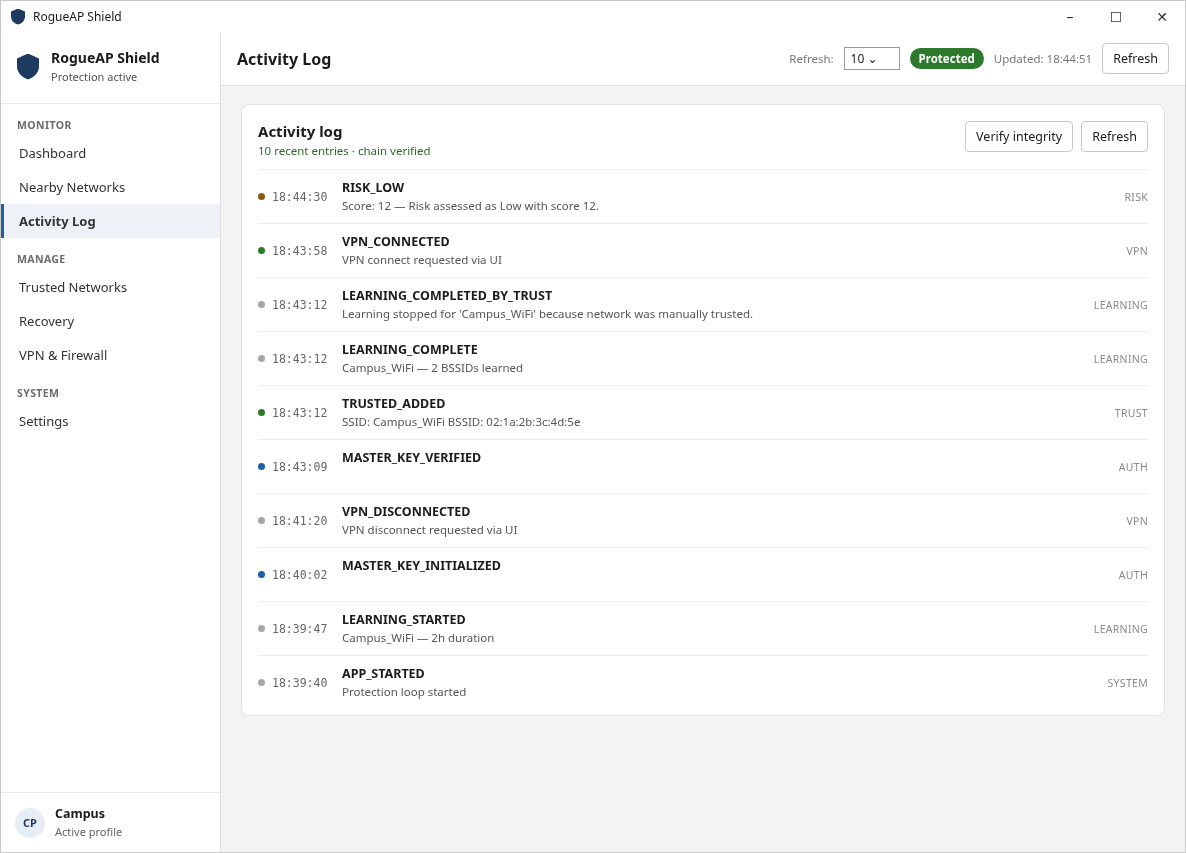
- Tamper-evident audit log. Every event is SHA-256 hash-chained to the previous one, so a deleted or edited entry is detected.
- VPN kill switch. When risk is high and the VPN fails to connect, outbound traffic is blocked using Windows Firewall rules (Windows Filtering Platform).
- Hardened command execution. VPN connect/disconnect commands are checked against blocked tokens and run with time-outs and retries.
- Safe by default.
Enforcement.DryRun=trueuntil you deliberately switch it off. - Control API on localhost only; changes to trusted networks or VPN settings need the master key.
- Portable admin profiles (
.rapf) exported with AES-256-GCM.
Testing
- A live evil-twin attack recreated with a mobile hotspot.
- Multi-AP testing across 53 access points on a university campus network.
- All 15 functional and 7 non-functional requirements met.
Screenshots
Activity log with the hash-chain “Verify integrity” check (mockup with demo data):